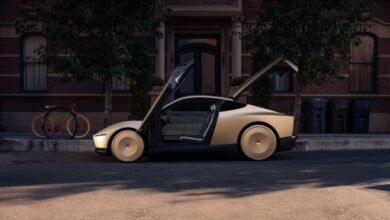

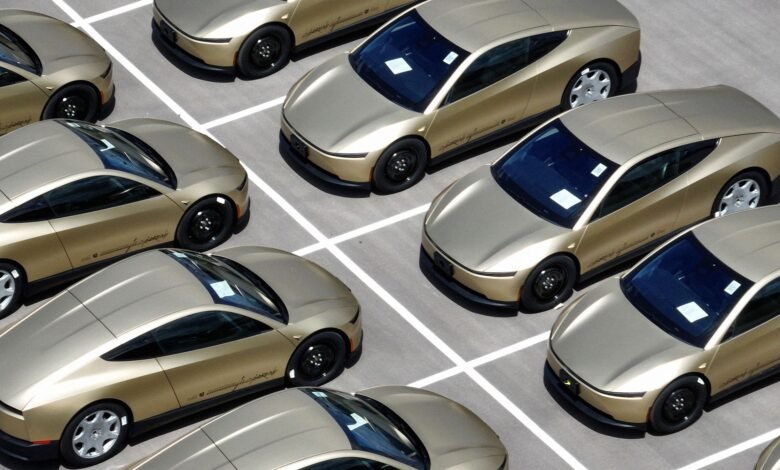
But for the road debut of the Cybercab, the driverless car that Tesla promises is not only the future of the company but also the global economy, an event in Austin came with no livestream. Invitees, many of them online Tesla influencers, were reportedly barred from posting about the event until hours after it started. And Musk wasn’t there at all. It was a somewhat peculiar start for the Cybercab, a matte gold two-seater first introduced in 2024.
Now 45 of the vehicles, which do not have steering wheels or pedals, are registered to operate on Tesla’s robotaxi network in Texas. On Thursday night, after the news embargo lifted, the online influencers who attended the event began to post sanguine reviews and clips from their first Cybercab rides. The Cybercab is a make-or-break vehicle for Tesla. Musk and other executives have argued that investors should no longer think of the world’s most valuable carmaker as a carmaker.
“Really, we should be thought of as an AI robotics company,” the CEO said last year. “If somebody doesn’t believe Tesla is going to solve autonomy, I think they should not be an investor in the company.” Musk has said that hitting its marks in those areas would make Tesla not only the most valuable company in the world, but worth upwards of three times more than Nvidia, today’s market leader.
Hitting Wall Street-ready milestones hasn’t been easy
But hitting Wall Street-ready milestones hasn’t been easy for Tesla’s autonomous vehicle program, at least so far. Musk said in 2013 that Teslas would do 90 percent of their miles autonomously within three years; that didn’t happen. He said that 1 million Tesla autonomous vehicles would be on the road by 2020. (Today, 420 Tesla robotaxis are registered in Texas.) He said that the Robotaxi network would reach 50 percent of the US population by 2026.
Now Tesla needs a robotics win. Driving a Win
Tesla’s robotaxi network officially launched in Austin in June of last year, with a handful of Model Y electrics. At the time, those cars came with human safety monitors in the front passenger seats, ready to intervene if the technology made mistakes. Since then, Tesla says that it’s taken human monitors out of many of its cars. The service is now picking up riders in a handful of cities in Texas and Florida, and has permits to operate in Arizona and Nevada.
A ride-hail service in California must have a human driver behind the wheel of each “robotaxi” because Tesla does not have permits to operate driverlessly there. Tesla executives say it will win the self-driving race because the cars depend on just inexpensive cameras to operate, making them much cheaper than those from competitors including Waymo and Zoox. (Those companies also use more expensive radar and lidar setups.)
Right now, though, the automaker feels behind.
Tesla AI software head Ashok Elluswamy announced
Tesla AI software head Ashok Elluswamy announced at Thursday’s event that the company’s vehicles had collectively traveled 1 million miles without humans behind the wheel. Waymo, which now operates in 14 US metros, said it reached 1 million driverless passenger miles in January 2023. Tesla’s Cybercab vision is ambitious and wide-ranging. It plans to not only deploy the driverless vehicles on an Uber-like network, but to sell cars without driving controls directly to customers—and before the end of 2026, Musk posted months ago.
(This scheme would likely require several major changes to the law.) It also plans to offer entrepreneurial Tesla fans the opportunity to operate their own fleets of Cybercabs. An “interest form” posted on Tesla’s website today allows people to indicate whether they’re interested in Cybercab fleet vehicle purchasing. Open Questions
It’s not clear how the Cybercabs will legally operate in public.
Federal safety rules require that vehicles come with steering wheels and brake pedals, and also the systems that power those human driver-centric systems. Last month, the government granted its first-ever exemption for a purpose-built autonomous vehicle for the Amazon subsidiary Zoox, whose box-like vehicles don’t have human driving controls. The US federal government said this summer that it intends to fast track new rules that will make it easier for autonomous vehicles without those features to deploy in great numbers.
Those rules aren’t finalized yet
But those rules aren’t finalized yet. A spokesperson for the National Highway Traffic Safety Administration told WIRED that Tesla has not filed an exemption request for the Cybercab. “NHTSA is in contact with Tesla and is evaluating the situation,” the spokesperson said. A Tesla executive has said that the company does not need to apply for an exemption. And the Cybercab is just one part of Tesla’s projected future.
Musk has said many times that the Optimus humanoid robot project “has the potential to be the biggest product of all time.” Eventually, he has projected, the robot will usher in an “age of abundance” that will render human labor moot. “The robots will actually make so many robots and AI that they will actually saturate all human needs,” Musk said earlier this year. “You won’t be able to even think of something to ask the robot for at a certain point.
Like there would be such an abundance of goods and services.”
Questions remain about how exactly the robotaxi service works. Like other autonomous vehicle developers, Tesla says it has human remote operators ready to help or intervene if something goes wrong inside the car or on the road around it. Unlike other companies, Tesla allows remote operators to directly drive its cars from afar, at speeds up to 10 mph.
These human operators have been involved
These human operators have been involved in at least three minor robotaxi crashes, according to government data, including one in which a human drove an autonomous Model Y into a “hidden tree stump.” (Tesla reports that one has been hurt in these incidents.)
Still, Tesla executives seemed determined to have fun on Thursday, showing off the 22-inch screen in the center of the Cybercab’s console.
If you don’t have to drive, why not watch TV? “You can choose to be entertained or choose to be productive,” engineering director Silvio Brugada told the crowd. “Anything you can possibly do as long as you have your seatbelt on.” The crowd didn’t quite roar, but it did “woo” suggestively.
Source: www.wired.com